
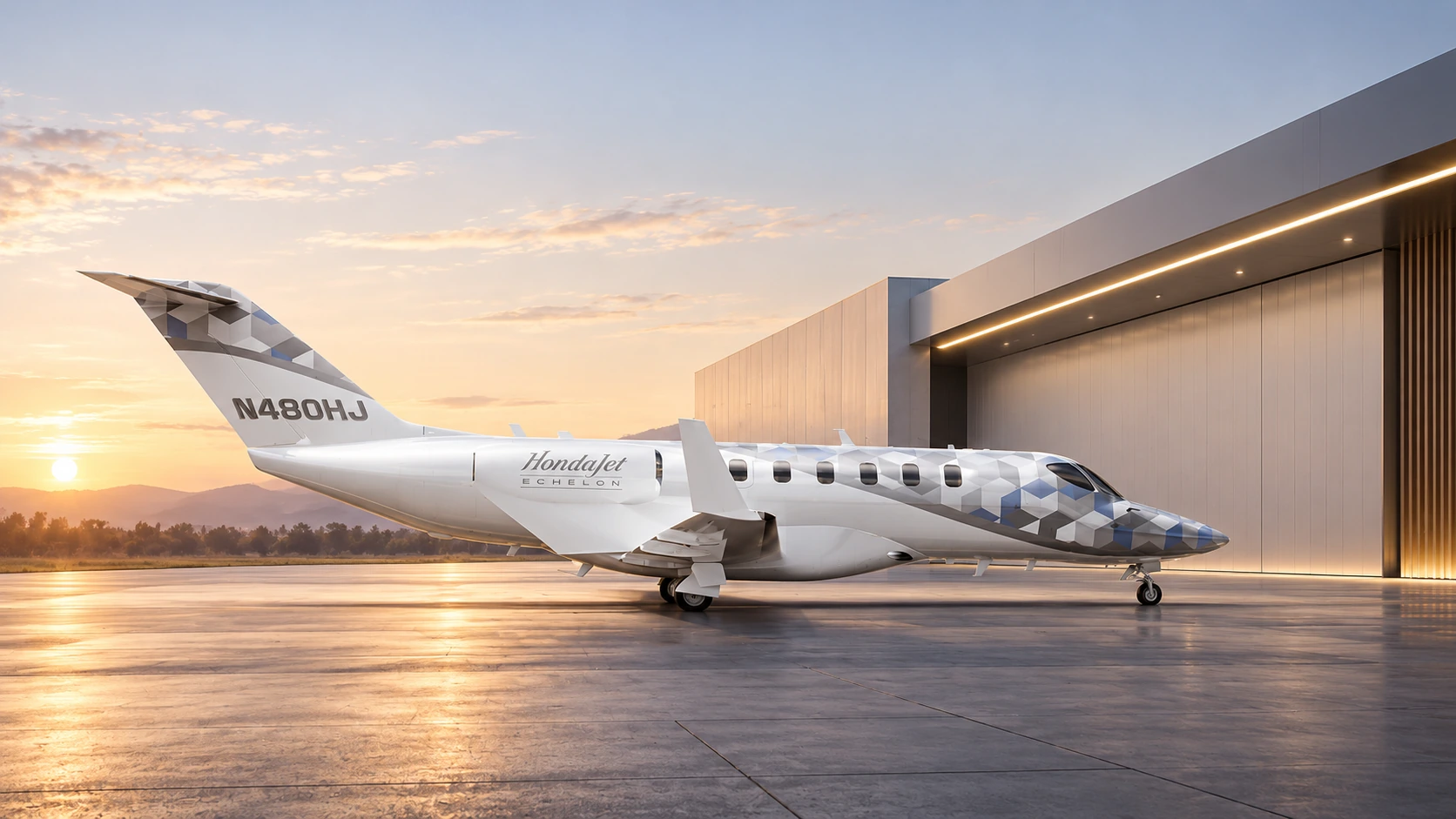
A completed wing is easy to overlook beside a polished aircraft rendering. It is also a more concrete development milestone. Honda Aircraft's first HondaJet Echelon wing structure now gives the program a substantial assembly to move into the next stages of aircraft integration.
The September 15, 2026 update brings progress and a revised timetable together. Honda is targeting first flight in 2028, followed by type certification and first delivery in 2031. Those dates are central to understanding the aircraft today.
What Honda has completed
The manufacturer's update reports a completed first wing structure, with five wing structures at different stages of final assembly. It also describes ongoing systems integration and a target to begin mainline final assembly in early 2027.
That is a useful sign of an aircraft taking shape. It does not establish how the complete machine will perform in flight. Structural assemblies, cockpit integration and equipment qualification address different pieces of the eventual aircraft, and the program has to bring them together into a reliable whole.
The timetable has moved
Honda attributes its updated schedule to supplier-related adjustments and continuing development work. The 2028 first-flight and 2031 certification/first-delivery targets supersede the earlier dates in its 2023 program announcement.
That matters when older brochures or news stories circulate alongside the new update. A development program should be judged against its current stated plan, with a clear distinction between a target and an achieved milestone.
For an operator considering an eventual fleet change, timing is part of the aircraft's usefulness. A promising future machine cannot cover a trip that needs an aircraft this year. Readers can admire the design while keeping that practical limitation in view.
The Echelon's intended role
Honda's product information presents a larger cabin and transcontinental ambitions, retaining the company's distinctive over-the-wing engine arrangement. The manufacturer is aiming for single-pilot operation, with additional automation planned to support the pilot.
| Item | Published target |
|---|---|
| NBAA IFR range | 2,625nm with one pilot and four passengers |
| Maximum cruise speed | 450 KTAS |
| Maximum cruise altitude | 47,000ft |
| Maximum occupants | One pilot plus ten passengers, or two plus nine |
| First flight / delivery | 2028 / 2031 targets |
These are preliminary design and schedule figures. Maximum occupancy is a count of available places, not a statement that the full published range can be flown with every seat occupied. The actual mission requires weight, fuel, reserves, route and weather to work together.
What would make the next update meaningful?
The useful signs will be completed integration, an assembled test aircraft and evidence from an actual flight-test campaign. Each can reduce a different kind of uncertainty. A first flight would be important, but even that would begin a further period of testing rather than finish the program.
The same discipline applies to customer interest. Honda reports letters of intent, which indicate demand for the proposal. They should not be counted as completed deliveries or assumed to carry identical contractual commitments.
A compelling proposition with work ahead
The Echelon aims to combine a relatively compact aircraft with a longer-distance role. That makes it part of the conversation explored in our SyberJet SJ36 feature: how much capability can a new light-jet design offer without moving passengers into a much larger aircraft?
For a more immediate production milestone, see the CJ4 Gen3 rollout. The Echelon's completed wing deserves attention on its own terms—as physical progress within a development program whose decisive flights are still ahead.
Image note: AI editorial illustration based on Honda’s Echelon concept reference; not a photograph of an assembled flight-test aircraft. Information checked October 29, 2026. ElitoLux has not independently flight-tested, sea-trialled or benchmarked the products described.