
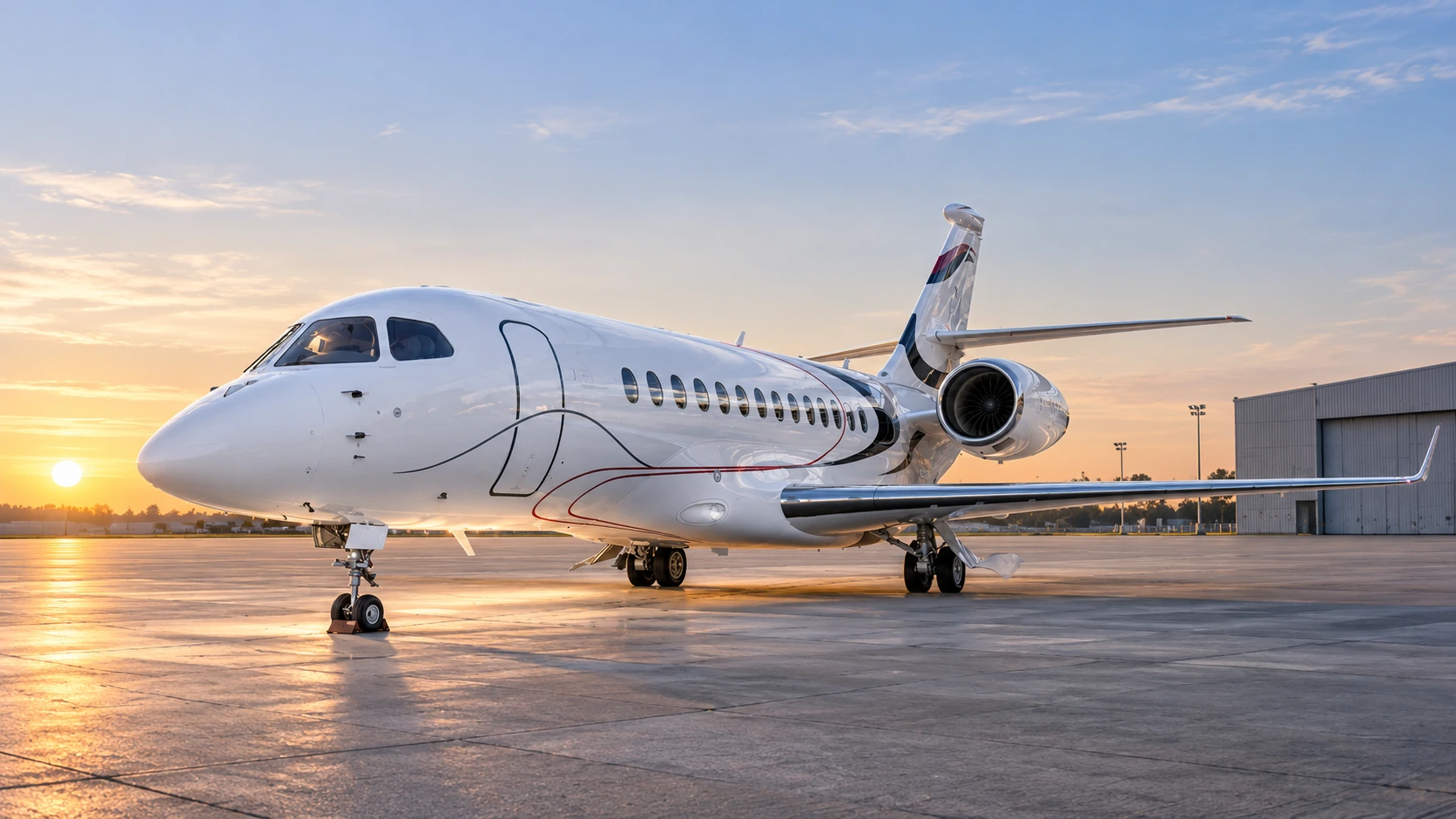
Specifications checked 31 October 2026. This is an aircraft guide, not a new-launch announcement. Both images are reference-based AI illustrations.
The Dassault Falcon 6X makes its strongest argument before takeoff. Its cabin measures 2.58 metres across and 1.98 metres high: space that matters when people need to pass each other, work at a table or settle in for a long flight.
Outside, the numbers tell a different part of the story. Dassault quotes a 5,500-nautical-mile range, but that figure belongs to a particular cruise setting and passenger assumption. Understanding the cabin and the range together is more useful than treating either as a trophy specification.
How big is the Falcon 6X cabin?
| Measurement | Published figure |
|---|---|
| Cabin width | 2.58 m / 8 ft 6 in |
| Cabin height | 1.98 m / 6 ft 6 in |
| Cabin length, excluding flight deck and baggage | 12.30 m / 40 ft 4 in |
| Cabin volume, excluding flight deck and baggage | 52.2 m³ / 1,843 ft³ |
| Baggage volume | 4.4 m³ / 155 ft³ |
| Manufacturer passenger configurations | 12–16 |
Source: Dassault Aviation’s Falcon 6X specifications and current Falcon product page. Dimensions describe the cabin envelope, not every point around a furnished seat.
Width is especially interesting because it gives a designer choices. It can become a more generous aisle, a different seating arrangement or useful space beside a table. It does not automatically make every proposed layout equally comfortable.
For a cabin visit, picture a normal moment rather than an empty showroom: one person crossing the aisle while another works, a meal being served, or someone trying to rest away from a conversation. Those situations reveal how well the plan uses its available space.
Is the Falcon 6X a 5,500-nm jet at every speed?
No. Dassault publishes 5,500 nm at Mach 0.80 and 5,100 nm at Mach 0.85. Its technical backgrounder gives the longer-range case with eight passengers, three crew, standard conditions, zero wind and NBAA IFR reserves. The maximum operating Mach number is 0.90; it is a limit, not the setting behind the longest-range claim.
The difference between the two published ranges is 400 nm, approximately 7.3% of the longer figure. That is simple arithmetic from the manufacturer’s numbers, not an independently measured fuel-burn curve.
This gives a prospective operator a useful starting question: is saving time through a higher cruise setting worth reducing the margin available for the trip? There is no universal answer. A flight department should compare actual city pairs with the intended payload, reserves, routing and expected winds.
Do not turn a brochure radius into a guaranteed nonstop journey. Ask for the same mission to be planned at both settings, including the arrival airport and alternate. That makes the trade-off visible without inventing a block time from Mach numbers alone.
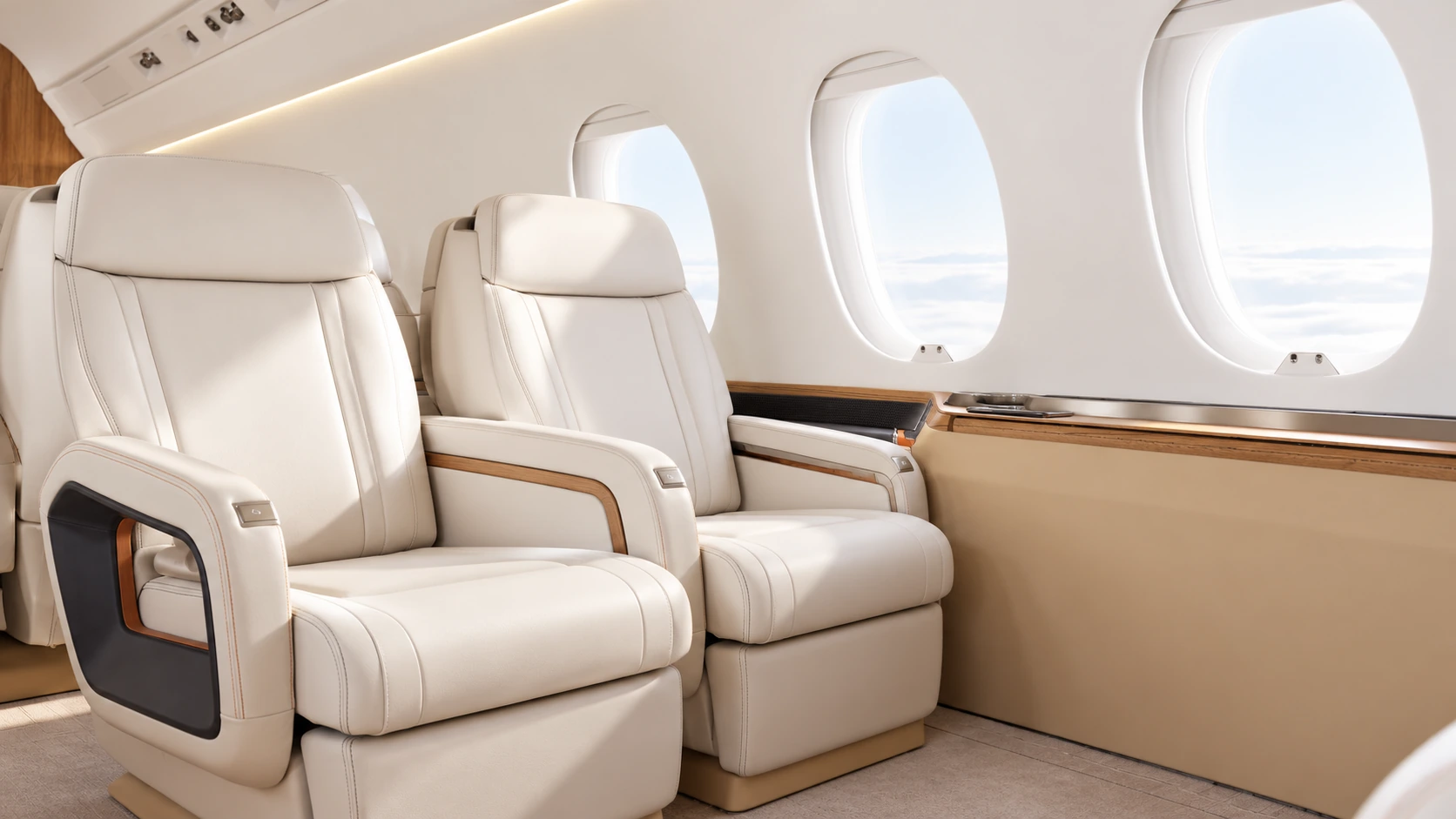
Three living areas still need a clear purpose
Dassault describes three lounge areas and advertises 30 windows plus a skylight. The design opportunity is to give different activities their own space, rather than repeat the same seating group from front to back.
Start with the flights the aircraft would make most often. A team travelling together may value a proper meeting arrangement. A smaller group on longer sectors may place more importance on a quiet rear area. A high seat count should not be read as the number of people who can sleep comfortably.
Inspect the proposed configuration with tables open and seats in their intended positions. Check the route to the lavatory and the storage available when everyone has brought luggage. The important question is how the aircraft works when occupied.
The engineering beyond the cabin
The 6X uses two Pratt & Whitney PW812D engines and Dassault’s EASy IV flight deck. Dassault also identifies its digital flight controls and flaperons as part of the aircraft’s approach and handling design.
For a reader, the distinction is between a published capability and an operating clearance. A short-distance figure or a low approach speed does not independently establish that a particular flight can use a particular runway. Aircraft configuration, airport procedures and crew requirements still need a mission-specific assessment.
Quick answers
How many passengers can it carry?
Dassault lists configurations for 12–16 passengers. The actual aircraft’s approved layout governs; the eight-passenger range assumption is a separate figure.
How fast can it fly?
The published maximum operating speed is Mach 0.90. The two range figures above use lower cruise settings.
What should I compare first?
Compare the cabin arrangement and a realistic mission at the same time. Neither a seat count nor maximum range alone tells you whether the aircraft fits the job.
For a different cabin philosophy, explore our Gulfstream G700 guide. Our Falcon 10X coverage examines a separate development programme.
Sources and method
- Dassault Falcon — current 6X product information
- Dassault Aviation — cabin and performance specifications
- Dassault — February 2024 technical backgrounder and range conditions
Manufacturer figures are distinguished from ElitoLux calculations and editorial interpretation. We have not flown or independently tested the aircraft. Read our editorial and corrections policy.