
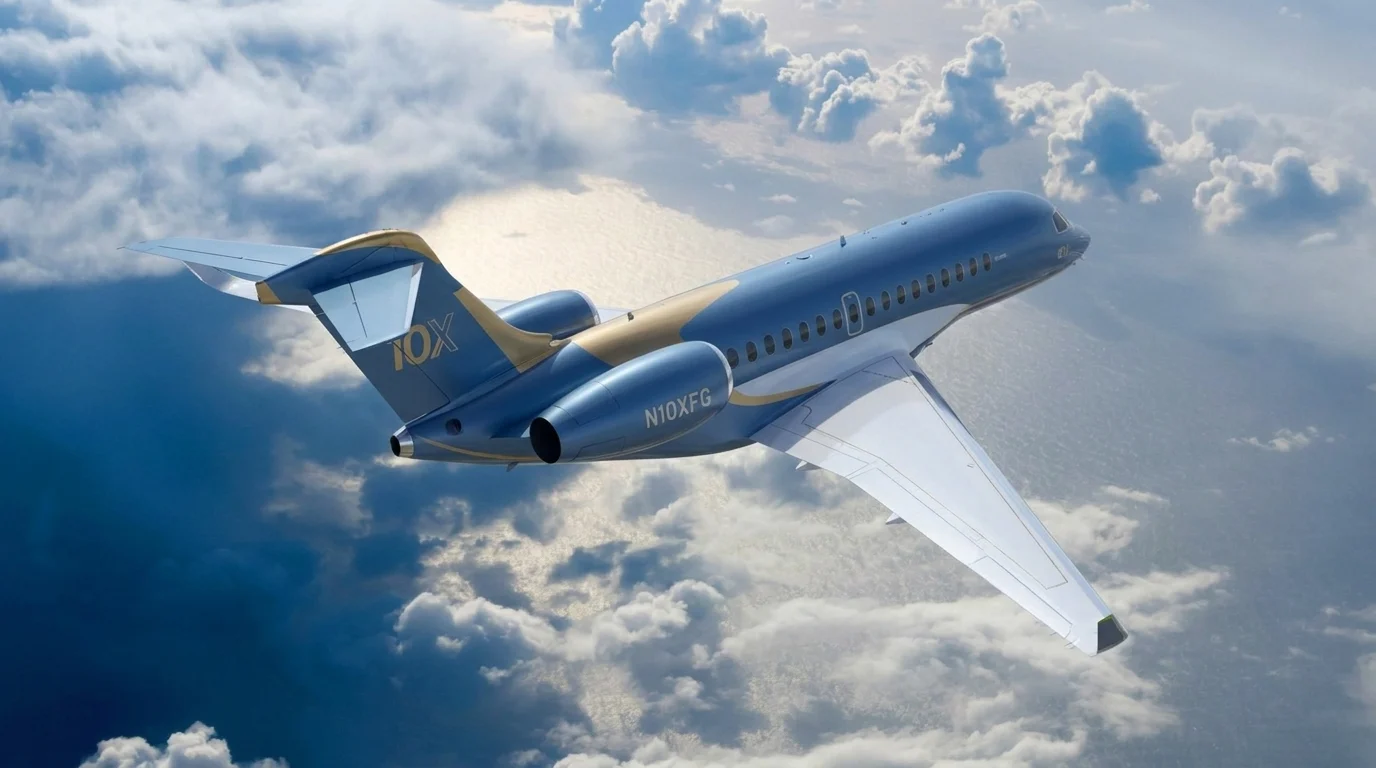
The most interesting thing about the Dassault Falcon 10X is how much attention it gives to the hours between takeoff and landing. Range gets a business jet across an ocean. Cabin space determines what those hours actually feel like.
Dassault’s new flagship is built around a notably broad cabin, with room for owners to give work, meals and sleep their own space. That promise now has a flying aircraft behind it. The 10X completed its maiden flight on June 19, 2026, although customers face a longer wait: Dassault’s latest published timetable puts entry into service in 2029.
This is an independent analysis of the development program and published specifications, rather than a flight test or an onboard review. Information checked October 18, 2026. Cover and interior images are editorial illustrations supplied by ElitoLux; they should not be treated as documentation of a specific aircraft configuration or flight.
What changed in 2026?
After its March 10 rollout at Bordeaux-Mérignac, the Falcon 10X took to the air from the same airport on June 19. Dassault says the first flight lasted two hours and 30 minutes. The crew assessed handling and systems at 15,000 feet before climbing to 40,000 feet and reaching Mach 0.82.
That is a meaningful step for an entirely new aircraft. It is also the beginning of the harder, less glamorous work: expanding the flight envelope and demonstrating that the aircraft and its systems behave as intended across the conditions required for certification. One successful flight cannot establish every advertised capability. Source: Dassault’s first-flight announcement.
Why the wait until 2029 matters
In its July 22 first-half results release, Dassault scheduled the Falcon 10X’s entry into service for 2029. That is a program target, rather than a guaranteed delivery date for an individual customer.
The same release reported 23 Falcon orders in the first half of 2026, compared with eight a year earlier, and a backlog of 83 Falcons. These figures cover the Falcon business as a whole. They do not tell us how many buyers ordered the 10X, or establish a record for this particular model. Source: Dassault Aviation’s H1 2026 financial release.
For a prospective owner, the practical question is availability. A compelling design still needs to complete certification and enter service before anyone can judge its reliability in regular operation. For readers following the program, the next useful milestones will be verified progress through testing and certification, rather than another attractive cabin rendering.
A cabin designed around usable space
The Falcon 10X’s cabin measures 9 feet 1 inch wide and 6 feet 8 inches high, with a published volume of 2,780 cubic feet. Dassault describes it as the largest cabin in a purpose-built business jet. That qualification matters: converted airliners occupy a different category.
The basic interior concept starts with four zones, but their lengths can change with the chosen layout. An owner might give more room to dining and meetings, or devote a larger section to an aft suite. A queen-size bed and a lavatory with a stand-up shower are among the available configuration possibilities. They should not be assumed to appear in every aircraft. Source: Dassault’s Falcon 10X backgrounder.
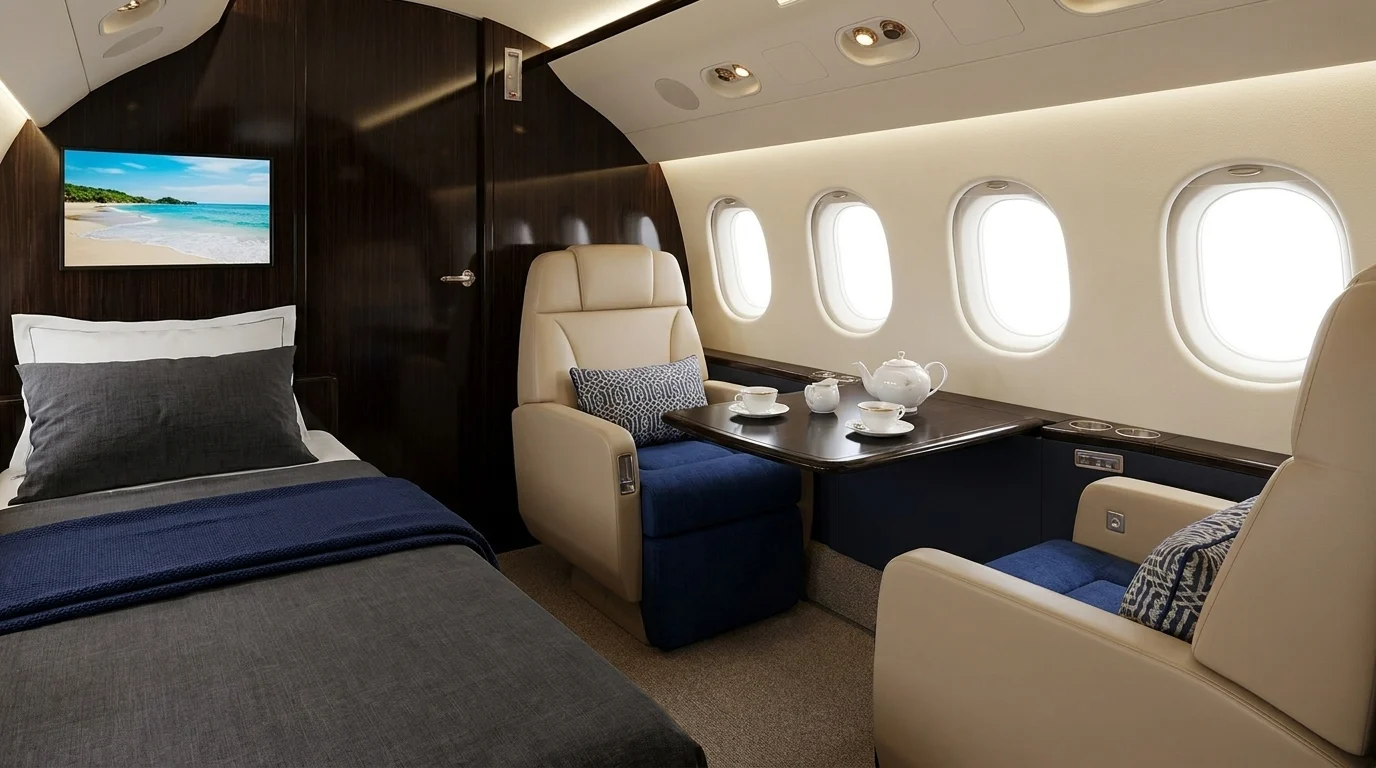
There is a useful distinction between a long cabin and a comfortable one. A narrow aisle can make an otherwise spacious aircraft awkward when somebody is eating, another passenger is working and the crew is serving a meal. Width has value because these activities have to coexist.
That is the appeal of the 10X’s approach. The bed and shower will attract attention, but the more everyday benefit may be the freedom to arrange the cabin around the people who regularly use it.
Light, air and the long-flight routine
Dassault specifies 38 windows and an in-flight-accessible baggage compartment. The windows are intended to spread daylight throughout the interior, while access to luggage is a practical detail on a long journey. Source: Falcon 10X product information.
The published cabin-pressure target is equivalent to 3,000 feet while flying at 41,000 feet. Dassault also describes individual zone temperature control and filtration that addresses ozone and volatile organic compounds. These are design features to assess as the program develops; they do not guarantee that every passenger will feel rested after an overnight flight. Source: Dassault’s Falcon Update magazine, issue 105.
Range and speed: read the conditions
Dassault publishes a maximum range of 7,500 nautical miles at Mach 0.85, using defined conditions including eight passengers, four crew and NBAA IFR reserves. Its maximum operating Mach number is 0.925. Those figures describe different things: the maximum-range figure is not a promise to fly that distance at the maximum operating speed.
The distinction is easy to lose in a specification headline. Payload, routing, weather, reserves and the finished aircraft’s configuration all affect the mission an operator can actually plan. For an owner, the useful comparison is a specific journey with a specific passenger load.
Falcon 10X specifications at a glance
| Specification | Published figure |
|---|---|
| Maximum range | 7,500 nm / 13,890 km at Mach 0.85, under stated conditions |
| Maximum operating Mach | 0.925 |
| Cabin width | 9 ft 1 in / 2.77 m |
| Cabin height | 6 ft 8 in / 2.03 m |
| Cabin volume | 2,780 cu ft / 78.7 cu m |
| Maximum passenger capacity | Up to 19, depending on configuration |
| Engines | Two Rolls-Royce Pearl 10X turbofans |
| Thrust | More than 18,000 lbf per engine |
| Published takeoff target | Under 6,000 ft, sea level / ISA / maximum takeoff weight |
| Published landing target | Under 2,500 ft, sea level / ISA / typical landing weight, unfactored |
| Entry into service | Scheduled for 2029 in Dassault’s July 2026 results |
Aircraft remains in development. Performance figures are manufacturer-published targets/specifications, subject to certification and operating conditions. Sources: Dassault’s March 2026 specification sheet and the financial release linked above.
The Pearl 10X: a new engine partnership
Two Rolls-Royce Pearl 10X turbofans power the aircraft, each rated at more than 18,000 pounds of thrust. The program marks the first time a Rolls-Royce engine has been selected to power a Dassault business jet. The engine uses the Advance2 core and underwent flight testing on Rolls-Royce’s Boeing 747 testbed before the Falcon’s own maiden flight. Source: Rolls-Royce’s Pearl 10X flight-test announcement.
Rolls-Royce has also tested the Pearl 10X with 100% sustainable aviation fuel. That demonstrates fuel compatibility in testing. It should not be described as proof that the complete aircraft already has approval for unrestricted operation on 100% SAF. Source: Rolls-Royce’s SAF test report.
Composite wings and a more integrated flight deck
The 10X combines a new composite wing with the NeXus flight deck and Dassault’s digital flight controls. Its wing design aims to balance efficient high-speed flight with controlled low-speed handling. That balance is central to the aircraft’s appeal: crossing an ocean is more useful when the destination airport also suits the journey. Source: Dassault’s 2026 rollout announcement.
NeXus brings extensive touchscreen interaction and more integrated automation, including a single Smart Throttle control. The system is intended to simplify how the crew manages the aircraft. FalconEye combines enhanced and synthetic vision to improve situational awareness; that should not be read as blanket permission to land in zero visibility. Operational approvals and applicable minima still matter. Source: Dassault’s NeXus flight-deck overview.
Runway performance needs context
The published takeoff and landing figures are promising for an aircraft of this size. They are not a shortcut to deciding whether a particular airport is suitable.
The landing number is explicitly unfactored and assumes stated conditions. An operator must account for the applicable rules, aircraft weight, runway condition, weather and other limitations. Until certification and the approved operating data are available, these figures belong in a development-program comparison, rather than a guaranteed airport-access claim.
The ElitoLux view
The Falcon 10X makes its strongest argument through the way its cabin could be used. More room to move, a suite that can be given meaningful space and adaptable zones are understandable advantages on journeys long enough to include a working day and a night’ --- TRUNCATED --- 11,827 chars