
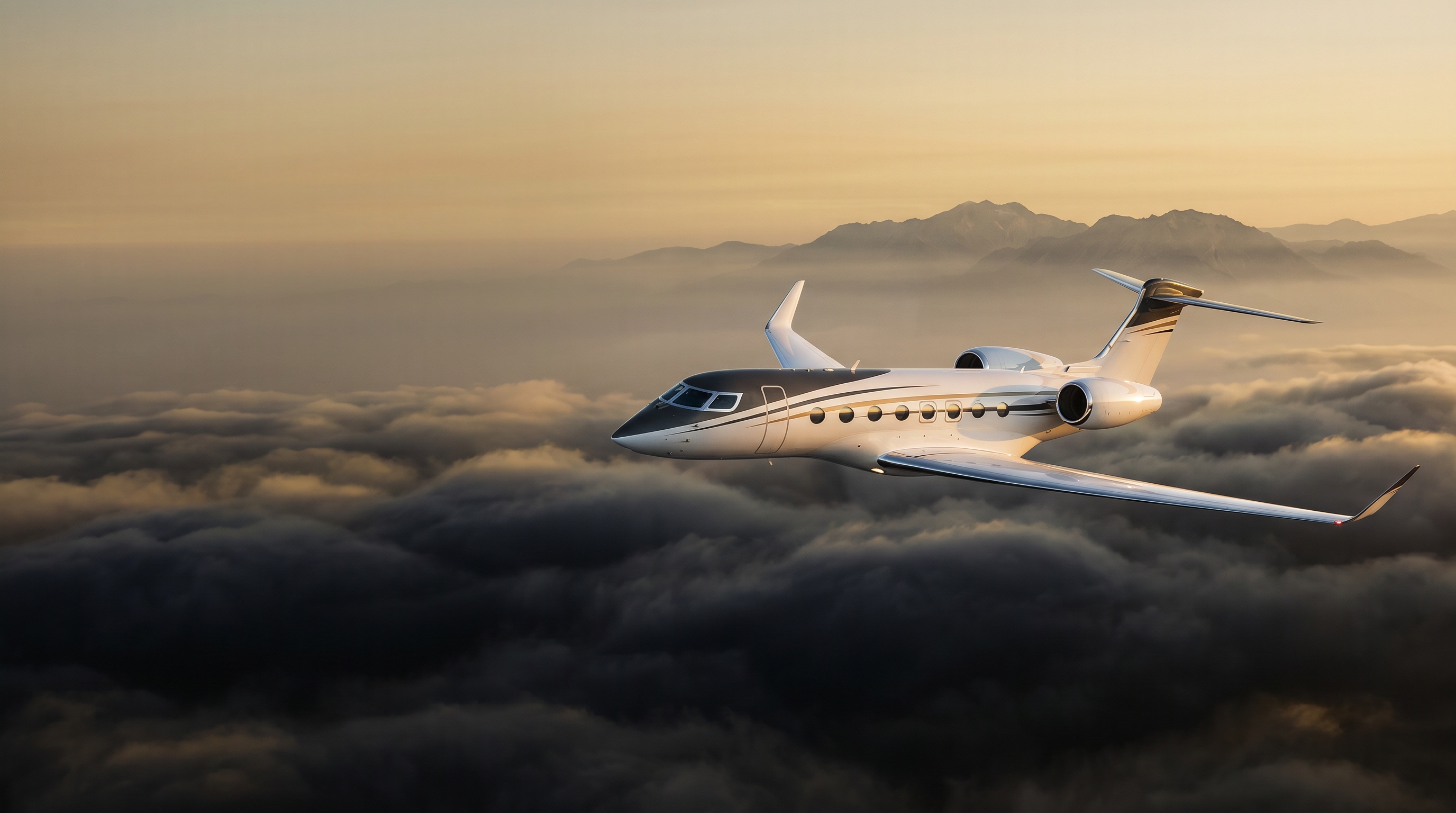
Updated 29 October 2026: range conditions, dimension definitions and comparison links checked against Gulfstream’s current specifications.
The Gulfstream G700 has a published range of 7,750 nautical miles at Mach 0.85 and a cabin measuring 17.35 metres long, excluding baggage. Those two numbers explain its appeal: long-distance capability and room to separate the activities of a long flight.
This guide answers the practical questions behind the specifications: how range changes with speed, which length describes the passenger cabin, and why the longest-range mission is not the same as carrying the maximum number of passengers. It is a source-based explanation, not a flight test.
G700 range and dimensions: quick answers
| Question | Answer |
|---|---|
| Range at Mach 0.85 | 7,750 nm / 14,353 km |
| Range at Mach 0.90 | 6,650 nm / 12,316 km |
| Finished cabin height and width | 1.91 m × 2.49 m (about 6 ft 3 in × 8 ft 2 in) |
| Cabin length, excluding baggage | 17.35 m (about 56 ft 11 in) |
| Total interior length | 19.41 m (about 63 ft 8 in) |
| Aircraft exterior length | 33.48 m (about 109 ft 10 in) |
Source: Gulfstream’s G700 specifications and range notes. Both range figures use eight passengers, four crew and NBAA IFR reserves. They are theoretical planning references; routing, weather and outfitting affect the result.
Why the two range figures differ
Moving from the advertised Mach 0.85 condition to Mach 0.90 reduces the quoted range by 1,100 nautical miles, approximately 14.2%. That percentage is our calculation: (7,750 − 6,650) ÷ 7,750. It describes the two published figures, not fuel consumption or a measured trip.
A route inside the lower figure still needs proper flight planning. A headwind, an alternate airport or a heavier cabin fit can change the margin. Nor can a route’s distance divided by a headline speed produce a dependable door-to-door journey time: taxiing, climb, descent and routing must also be allowed for.
Which G700 length should you compare?
The passenger-cabin measurement, the total interior measurement and the aircraft’s nose-to-tail length answer different questions. Use the same definition for both aircraft in a comparison. Comparing one jet’s total interior length with another’s cabin length would exaggerate the difference.
Inside, usable space also depends on the arrangement. A floor plan shows whether the space supports the way a group travels: working together, eating, resting or having separate conversations. Ask to see the exact layout rather than infer the seating arrangement from a maximum passenger count.
Performance
Long-range capability is only part of the G700 story. Gulfstream also designed the aircraft to travel quickly. Its long-range cruise speed is Mach 0.85, while high-speed cruise is Mach 0.90.
The maximum operating Mach number is Mach 0.935, giving the aircraft a strong combination of speed and range for long-distance business travel.
Gulfstream also publishes a high-speed cruise range of 6,650 nautical miles at Mach 0.90, demonstrating how the aircraft can trade some maximum range for faster journey times.
Rolls-Royce Pearl 700 Engines
Power comes from two Rolls-Royce Pearl 700 turbofan engines. Gulfstream lists each engine at 18,250 pounds of rated takeoff thrust.
The engines work together with the G700’s aerodynamic fuselage, wing design and winglets to support both high-speed operation and long-distance efficiency.
The Largest Gulfstream Cabin
The cabin is one of the G700’s defining features. Gulfstream describes it as its largest cabin and offers configurations with up to five separate living areas.
Depending on configuration, the aircraft can seat up to 19 passengers and provide sleeping accommodation for up to 13.
The finished cabin measures approximately 6 feet 3 inches in height and 8 feet 2 inches in width. Cabin length, excluding baggage, is approximately 56 feet 11 inches, while total interior length reaches about 63 feet 8 inches.
The G700 is designed less like a conventional aircraft cabin and more like a sequence of private rooms connected inside one long-range flying space.
Five Living Areas
The ability to divide the cabin into as many as five living areas gives owners considerable freedom when configuring the aircraft.
A typical interior can include dedicated zones for dining, meetings, relaxation, entertainment and sleeping. Gulfstream also offers layouts that can include an ultragalley and a grand suite.
For passengers spending ten hours or more onboard, this separation matters. A meeting can take place in one section while another passenger rests or works privately elsewhere in the cabin.
Cabin Comfort and Atmosphere
The G700 uses Gulfstream’s panoramic oval windows, with 20 installed throughout the cabin. Their size and spacing bring substantial natural light into the interior while also contributing to the aircraft’s recognizable Gulfstream design language.
Gulfstream lists a cabin altitude of approximately 2,840 feet while the aircraft is flying at 41,000 feet. Lower cabin altitude can help reduce the physical effects passengers may experience during long flights.
The combination of low cabin altitude, large windows, flexible seating and sleeping areas is intended to make very long journeys feel less like time spent in transportation and more like time spent in a private living environment.
Symmetry Flight Deck
Up front, the G700 uses Gulfstream’s Symmetry Flight Deck. The cockpit includes active control sidesticks, touchscreen avionics and systems designed to reduce pilot workload.
Gulfstream also equips the aircraft with its Combined Vision System, displayed through dual head-up displays, along with technologies such as its Predictive Landing Performance System.
These systems are designed to improve situational awareness and support crews during demanding phases of flight.
Gulfstream G700 Specifications
| Specification | Gulfstream G700 |
|---|---|
| Maximum Range | 7,750 nm |
| Long-Range Cruise | Mach 0.85 |
| High-Speed Cruise | Mach 0.90 |
| Maximum Operating Mach | Mach 0.935 |
| High-Speed Cruise Range | 6,650 nm |
| Maximum Cruise Altitude | 51,000 ft |
| Takeoff Distance | 5,995 ft |
| Passengers | Up to 19 |
| Sleeps | Up to 13 |
| Living Areas | Up to 5 |
| Cabin Height | 6 ft 3 in |
| Cabin Width | 8 ft 2 in |
| Cabin Length | 56 ft 11 in |
| Panoramic Windows | 20 |
| Engines | 2 × Rolls-Royce Pearl 700 |
| Takeoff Thrust | 18,250 lb per engine |
How Far Can the G700 Fly?
A maximum published range of 7,750 nautical miles gives the G700 the ability to connect many of the world’s major commercial and financial centers without a fuel stop under suitable operating conditions.
Actual range will vary depending on aircraft configuration, passenger and baggage load, winds, air traffic routing, weather and reserves. Gulfstream’s published figure is based on defined NBAA IFR theoretical conditions rather than a guarantee for every mission.
Can it carry 19 passengers for 7,750 nautical miles?
The published figures do not establish that combination. The maximum seating capacity describes available configurations, while the quoted range uses eight passengers. An operator needs the actual aircraft weight, passenger and baggage load, reserves and route conditions to answer a specific mission.
Does the G800 go farther?
Yes: its published Mach 0.85 range is 450 nautical miles greater. The G700 has the longer cabin. Our G800 versus G700 comparison explains the trade-off and provides a checklist for comparing a recurring trip on equal terms.
For a smaller model in the same family, read the G400 cabin-flight update. Browse all private-jet guides and news.
Sources and method
Specifications were checked against the linked manufacturer pages on 29 October 2026. Percentage and unit comparisons are arithmetic based on those published figures. They are not operational advice, a flight test or an ownership-cost quotation. Read how ElitoLux researches and updates its articles.