

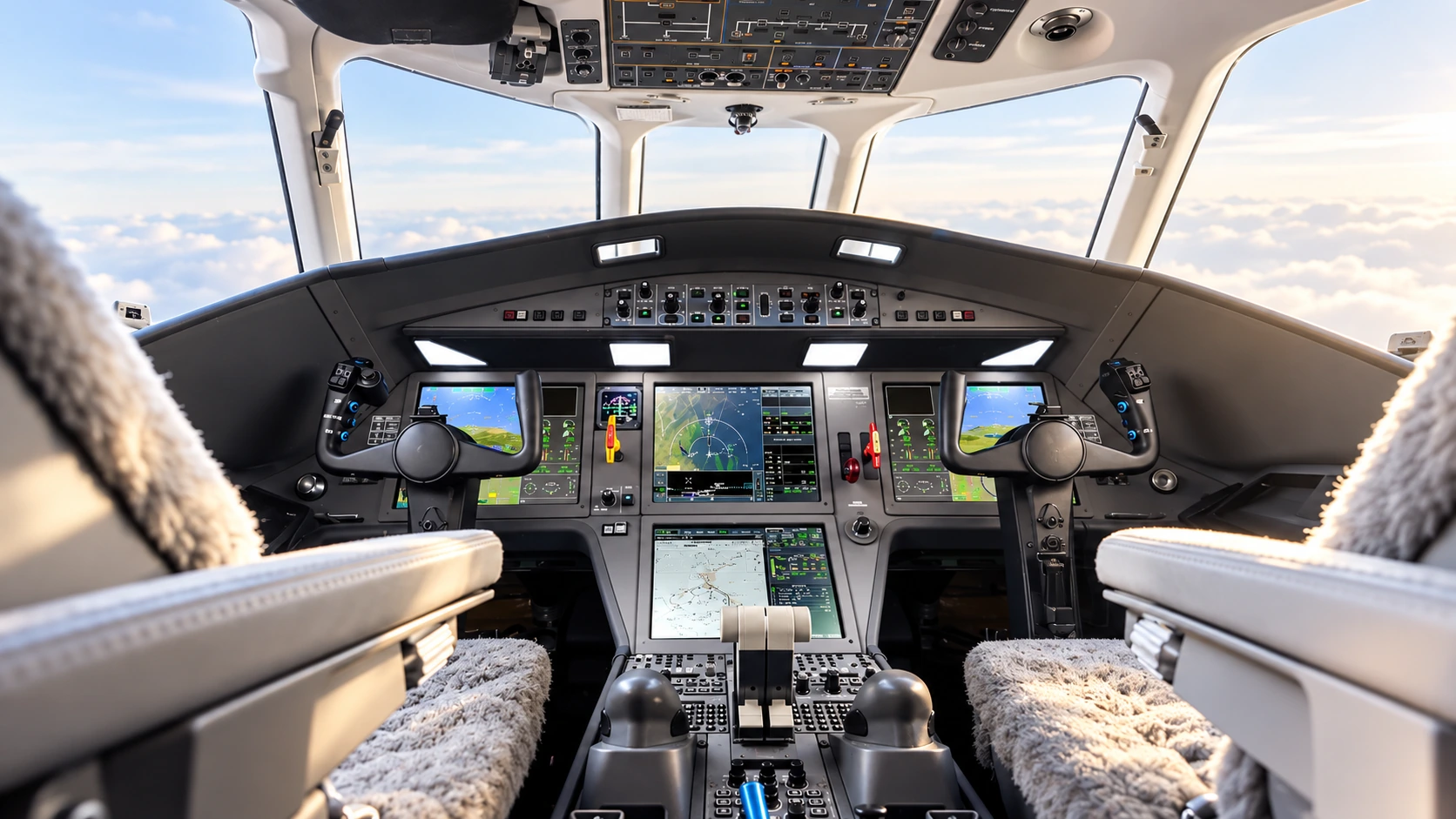
Reported 1 November 2026 from Dassault’s 20 October announcement and product information checked today. Both images are reference-based AI illustrations.
The Falcon 2000’s next significant change is planned for the pilots’ seats. Dassault has announced that its fourth-generation EASy IV flight deck will be offered on the production Falcon 2000LXS, with a retrofit path also planned for existing Falcon 2000 EASy-series aircraft.
For a family that Dassault says has passed 700 aircraft since entering service in 1995, that makes the announcement relevant well beyond a future delivery. It opens a modernisation conversation for operators who already know the aircraft and want to keep using it.
A production update and a route for existing aircraft
Dassault made the announcement in Las Vegas on 20 October 2026. Its stated scope covers the production 2000LXS and a retrofit offering for the Falcon 2000 EASy series.
The word “EASy” is important. An owner should identify the exact aircraft and installed avionics before treating the announcement as confirmation of eligibility. The release’s wording should not be expanded into a blanket promise covering every original Falcon 2000 cockpit.
There is also a difference between a programme announcement and the equipment fitted to a particular aircraft. As checked on 1 November, Dassault’s 2000LXS product specification table still lists EASy II. The October release establishes the plan for the next generation; it does not establish that every current delivery or existing airframe has already changed.
What does EASy IV bring?
| Area | Announced change |
|---|---|
| Processing | More processing power and clearer displays |
| Airport views | Moving maps in both 2D and 3D |
| Charts | New Jeppesen chart features |
| Navigation | A new flight-management system with RNP approach capability |
Source: Dassault’s 20 October 2026 announcement. The table describes the announced programme, not a confirmed installation specification for an individual aircraft.
The value of an avionics update is easier to understand when thinking about a busy part of a flight. Pilots need to connect their route, the airport layout and the aircraft’s position without losing the wider picture. Better presentation can make that information easier to interpret.
That is the useful lens for this announcement: how the information supports the crew’s work. A brighter display or faster processor matters most when it helps the crew use the right information at the right moment.
Two views of the same airport
Dassault’s broader EASy IV material describes the 2D moving map as an interactive view of airport features, including taxiways, runways, holding points, parking stands and areas identified as incursion hotspots. The 3D view complements it with an airport depiction on the primary flight display during arrival and ground operations.
Those views answer related but different questions. A plan view helps explain how the airport fits together; a forward-looking view helps relate that layout to what lies ahead. This is an explanation of the interface concept, rather than an independent assessment of pilot workload or measured safety outcomes.
Dassault also discusses EASy IV alongside FalconEye, its combined-vision system, for low-visibility situational awareness. The wording is conditional: benefits described when the systems are combined should not be read as proof that every retrofit automatically includes the same vision equipment.
The practical question is the complete installation
For an existing operator, a retrofit can be more relevant than a new aircraft brochure. It creates the possibility of retaining a familiar airframe while updating the place where the crew does its work.
The meaningful comparison is between the aircraft’s current configuration and the proposed finished installation. That includes the functions being added, the hardware and software involved, and how the crew will prepare to use them. A family-level announcement cannot supply those aircraft-specific details.
Before committing to a slot, an operator would need written confirmation of eligibility, the scope of work, expected downtime, training requirements and total cost. The reviewed announcement does not publish a universal package price or installation duration.
What stays familiar about the 2000LXS?
The product page continues to quote 4,000 nautical miles of range with eight passengers and NBAA IFR reserves, together with a cabin 2.34 metres wide and 1.88 metres high. It lists configurations for eight to ten passengers.
Those figures provide context for the aircraft receiving the planned flight-deck change. The announcement is not presented as an increase in range or a larger passenger cabin. Its significance lies in modernising the operating environment of an established aircraft family.
When can an owner get the upgrade?
The October 20 release says Dassault plans to offer it, but does not specify a firm first-installation date or a delivery date for a particular customer. Current production availability and retrofit scheduling therefore need confirmation from Dassault for the aircraft concerned.
That leaves a clear next milestone to watch: a defined installation and availability programme. For now, the news is the manufacturer’s commitment to bring its newer flight-deck generation to both production and eligible existing Falcon 2000 aircraft.
For context on EASy IV in another Falcon, read our Falcon 6X cabin and range guide. Explore more aircraft updates in the Private Jets collection.
Sources and method
- Dassault — Falcon 2000 EASy IV announcement, 20 October 2026
- Dassault — EASy IV functions and airport-map explanation
- Dassault — current Falcon 2000LXS product specifications
This report separates manufacturer statements from ElitoLux interpretation. We have not flown or independently tested the upgrade. General EASy IV material provides context; individual aircraft equipment and operational approvals must be confirmed separately. Read our research and corrections policy.