
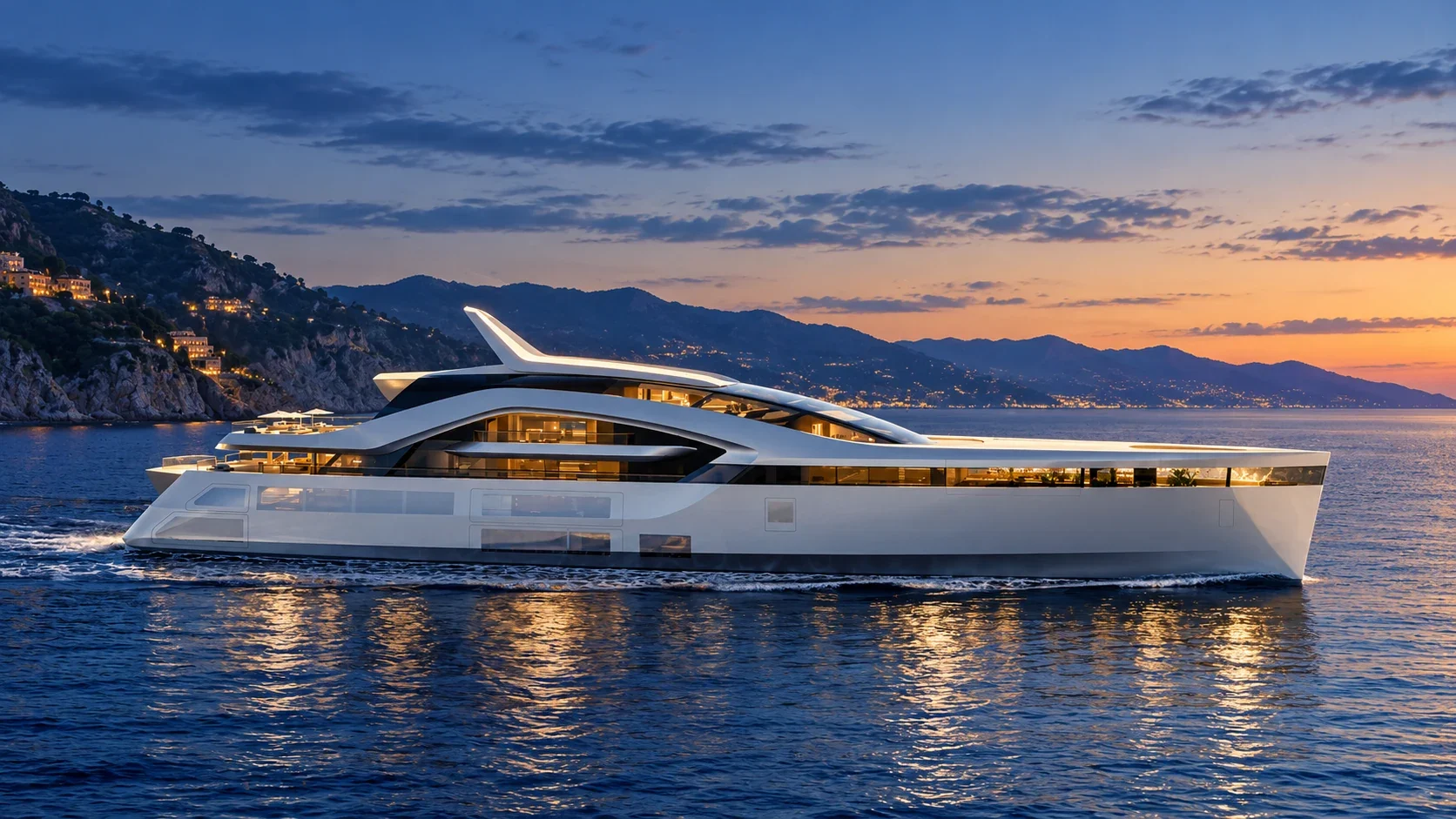
Editorial note: Images are AI-generated illustrations made with manufacturer reference images. They are not manufacturer photographs, engineering drawings or evidence of a hands-on test. Information checked on 21 October 2026.
A yacht can be impressive in a photograph and awkward to live aboard. The more interesting design question is what happens between the photographable moments: how people meet, find privacy, move around and settle into an ordinary afternoon at sea.
Feadship’s HIVE concept, revealed on 24 September 2026, puts that question near the centre of the project. It is a design study, not a yacht that has been delivered to an owner.
A project worth understanding before judging
| Item | Announced detail |
|---|---|
| Length | 115 metres |
| Design | Studio De Voogt |
| Battery proposal | 5 MWh |
| Project status | Concept design |
The proposal includes a shared space spanning four decks and a hybrid electrical system with generators, fuel cells and batteries. It also specifies Voith Schneider propulsion. These are proposed design choices, not sea-trial findings.
Luxury measured in useful space
Our reading of HIVE is that its most persuasive idea is flexibility. A room that supports conversation, a performance or quiet family time can offer more daily value than a room permanently arranged for an occasion that rarely happens.
That is easy to say in a concept presentation. The practical test is whether furniture, acoustics, circulation and service routes work together. A large gathering should not make the rest of the yacht inconvenient. A private afternoon should not leave the social spaces feeling like an empty venue.
These are the details we would want to see developed in a build brief. Where can someone take a call without overhearing the next group? Can guests reach the water without crossing a dining setup? Can crew support an event without turning the guest route into a working corridor? A good general arrangement quietly answers those questions.
The propulsion choice deserves attention
Voith’s 2026 explanation of the Schneider propeller describes vertical blades moving around a circular rotor while their pitch changes continuously. That lets the system direct thrust around the vessel rather than relying on a conventional propeller-and-rudder arrangement.
The manufacturer links this control to precise manoeuvring and positioning, and notes the technology’s established use in specialist vessels. Its electric version combines that operating principle with an integrated electric drive. This is useful background for understanding the proposal; it is not proof of HIVE’s eventual noise, efficiency or handling.
For an owner, the interesting outcome would be a calmer, more controllable experience close to shore or while holding position. For an engineer, it would be a whole-system question involving the hull, controls, electrical demand and operating profile. The distinction matters: fitting an interesting component is only one part of making a yacht work well.
Read the energy story carefully
A battery capacity is an amount of stored energy, not a promise of unlimited silent cruising. To turn capacity into operating time, you need to know the combined demand of propulsion and the hotel load: cooling, lighting, kitchens and the other services that make life aboard comfortable.
We would also separate operation at anchor from cruising and peak demand. An energy system can behave very differently across those situations. Emissions claims need similar care, including the fuel pathway and the boundary of the calculation. An attractive render cannot answer those engineering questions.
What to watch next
The meaningful next step would be evidence that the design is being translated into a contracted build, a detailed specification or independently documented testing. Until then, judging HIVE as a finished yacht would miss the point of a concept study.
Its value today lies in the questions it makes possible: what people actually want to do at sea, and which technologies could make that experience better.
Is HIVE available to charter?
The material reviewed presents HIVE as a concept. It does not establish a delivered charter yacht, a booking calendar or a charter price.
Continue through the Yachts collection, or explore another current engineering project in our Tesla Roadster analysis.