
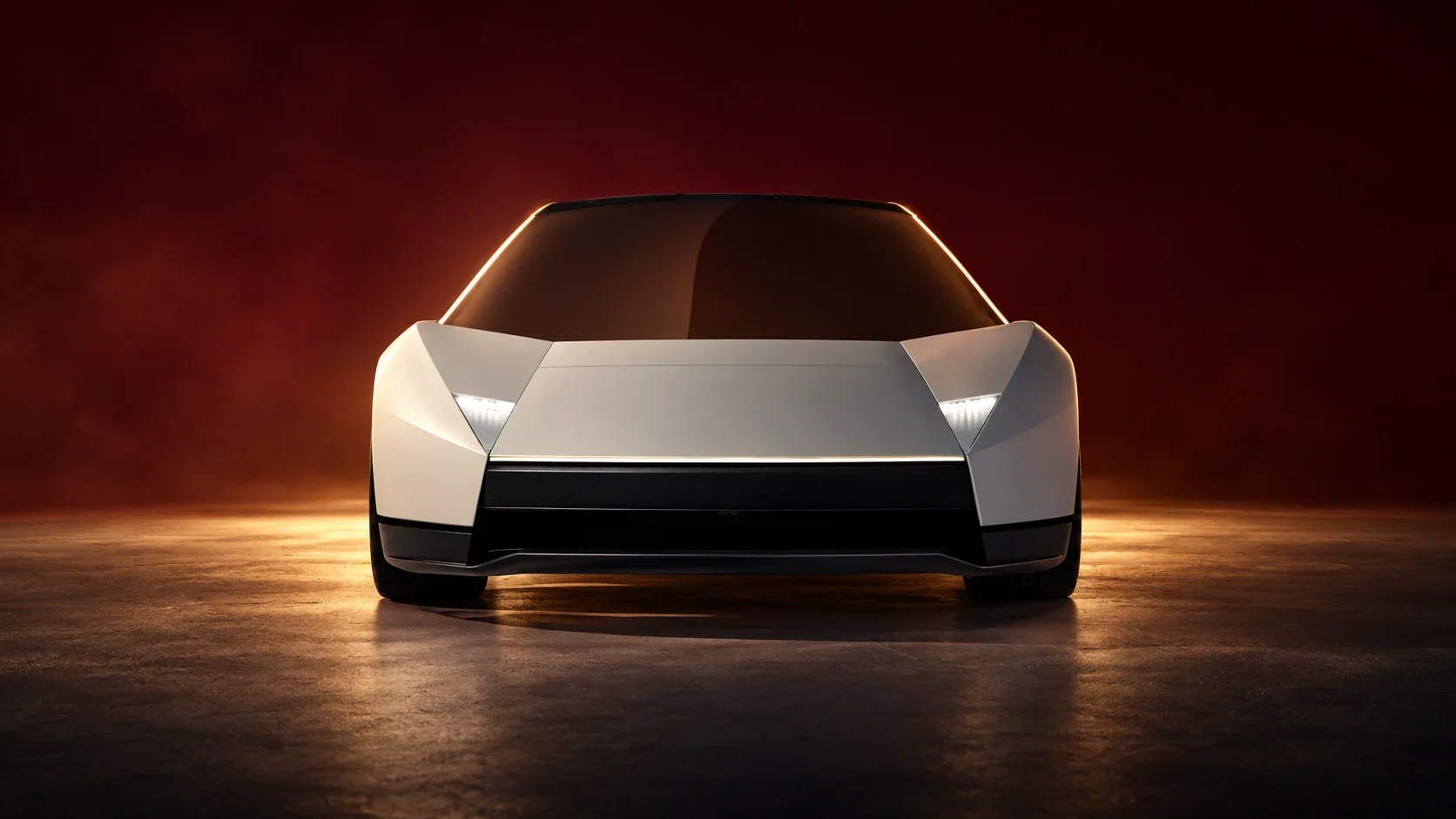
Editorial note: Images are AI-generated illustrations made with manufacturer reference images. They are not manufacturer photographs, engineering drawings or evidence of a hands-on test. Information checked on 21 October 2026.
The interesting part of Tesla’s current Roadster is no longer a single acceleration number. It is the distance between three very different propositions wearing the same name. Before judging the car, it helps to know which one is being discussed.
Tesla’s current product page separates Performance, Thrust and Rocket. Treating every feature on that page as standard equipment would produce a misleading picture of what a customer is reserving.
The three Roadsters described today
| Version | What Tesla describes |
|---|---|
| Performance | Two seats, road-focused; reservations. |
| Thrust | Two seats, limited release; claimed 0–60 mph in under one second. |
| Rocket | One seat, invitation only; not approved for public road use. |
Tesla also limits some features by region and says the displayed features and specifications relate to the optional Thrust augment. Those qualifications belong beside the headline claims, rather than hidden at the end of a review.
Why the engineering is more interesting than the slogan
Tesla describes active aerodynamics, underbody suction and cold-gas thrusters. These are different ways of managing forces, and they should not be blurred into one vague promise of extra grip.
A conventional aerodynamic surface needs airflow to develop useful force. Increasing road speed changes that airflow, so the effect at the start of a launch differs from the effect farther down a straight. NASA’s explanation of aerodynamic lift is a useful foundation: air and a surface must interact, and relative motion matters. A powered fan can move air even while the vehicle itself is stationary.
That distinction explains why an unusual system might be useful. It does not establish how well this particular car performs. A beautiful demonstration and a repeatable test are different kinds of evidence.
For an independent assessment, the useful questions would concern repeatability, heat, energy consumption, surface conditions, maintenance and the transition between operating modes. A headline launch time answers none of those questions on its own.
The design has changed the conversation
The current reference imagery presents a faceted white body and a dark canopy, rather than the softer shape many readers associate with earlier Roadster coverage. Our illustration follows that current reference. It is worth checking the date of an image before using it to explain a new vehicle.
The same discipline applies to specifications. An old announcement, a current reservation page and an eventual production specification are separate documents. Figures should travel with their source, version and test conditions. Copying a familiar number from an older story can make a new article less useful, even when the number was reported accurately at the time.
What would make the Roadster convincing?
For a driver, the strongest evidence would be a clear specification for the chosen version, a documented delivery commitment and repeatable testing by people outside the manufacturer. For an enthusiast, the next useful development may be a detailed explanation of the hardware rather than another spectacular clip.
We are not assigning a delivery date, battery capacity, final price or verified acceleration result here. The sources reviewed do not establish those points consistently enough for this article to present them as settled.
The Roadster earns attention because it asks ambitious engineering questions. The rewarding way to follow it is to keep asking precise ones.
Questions readers are asking
Has ElitoLux tested this car?
No. This is a source-based editorial analysis. It includes no driving impressions or independently measured performance.
Does a reservation confirm delivery?
A reservation page alone does not establish an individual delivery commitment. Check the actual agreement, version, region and current written terms.
For another look at how ambitious performance figures should be read, explore our G800 versus G700 comparison, or browse the Cars collection.