
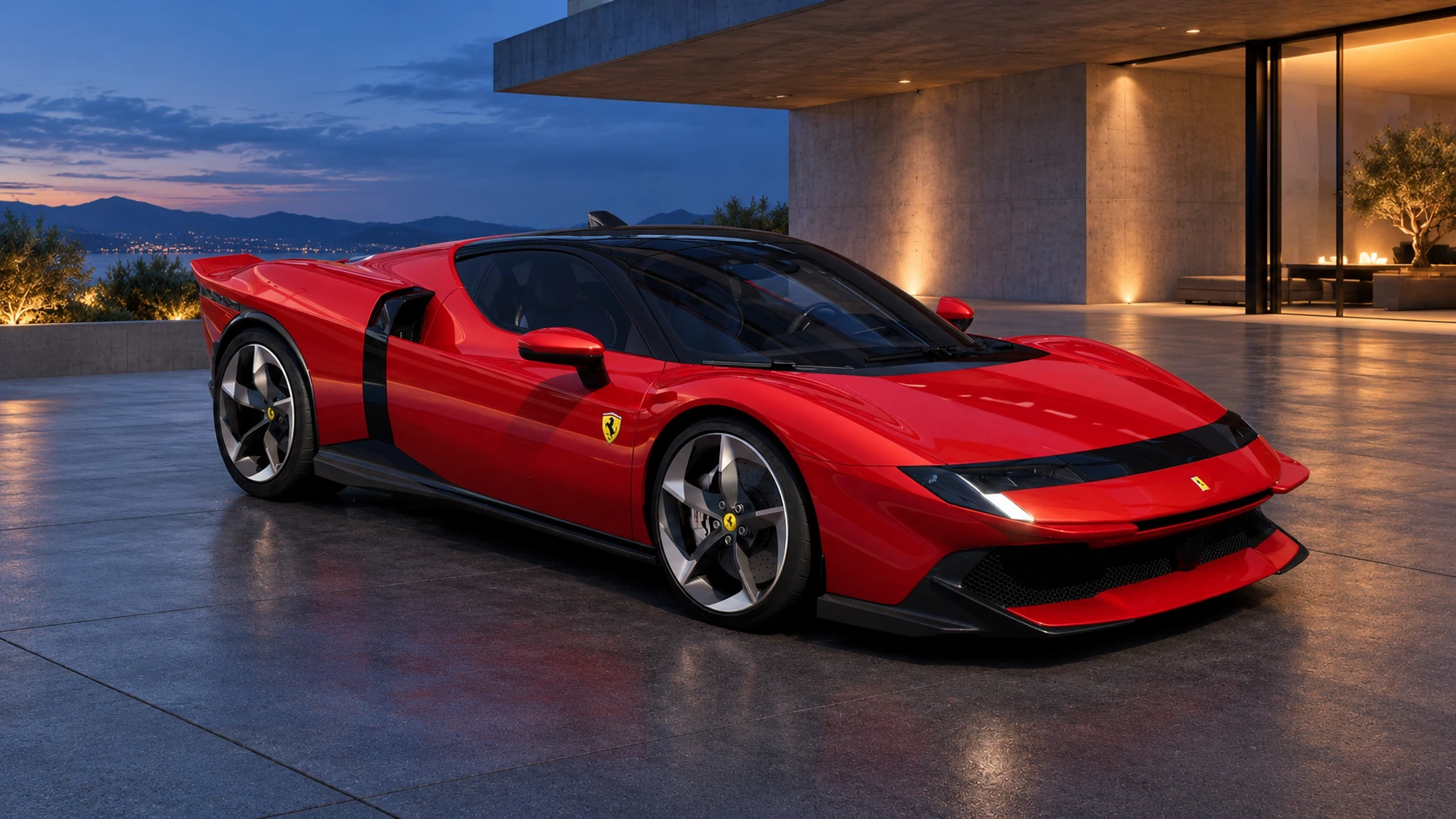
Information checked 30 October 2026. This guide covers the 849 Testarossa coupé, unveiled on 9 September 2025. Images are reference-based AI illustrations.
The Ferrari 849 Testarossa brings a famous name to a plug-in hybrid with a twin-turbo V8 and three electric motors. Its headline output is 1,050 cv. The interesting part is how those components work together—and what the headline leaves for a driver to discover.
It replaces the SF90 Stradale in Ferrari’s range. This is a guide to the published specifications and the questions they raise, rather than a road-test verdict.
Ferrari 849 Testarossa: essential specifications
| Specification | Published figure |
|---|---|
| Hybrid system output | 1,050 cv |
| Combustion engine | 3,990 cc twin-turbo V8 |
| V8 maximum power* | 830 cv |
| Battery capacity | 7.45 kWh |
| Maximum eDrive range | 25 km |
| 0–100 km/h | Less than 2.3 seconds |
| Maximum speed | More than 330 km/h |
Source: Ferrari’s launch release and technical information. The technical sheet marks the V8 power figure with “with optional content.” Outputs retain Ferrari’s cv units.
Where does the 1,050 cv come from?
Ferrari pairs the V8 with a rear electric motor and two front motors. It quotes 220 cv for the electric group. The headline figure describes the combined powertrain, rather than the petrol engine alone.
That distinction is useful when comparing cars. A system-output number tells you the stated peak capability of the complete package; it does not describe the accelerator response, sound or consistency you will experience in every driving situation. Those deserve separate questions.
For a prospective owner, the revealing demonstration would include ordinary driving as well as a hard acceleration run. How does the car respond to a small change of pedal position? How easily can the driver make a smooth exit from a junction? How does the transition between operating modes feel? A large output number cannot answer those questions by itself.
What does the electric-range figure tell you?
The battery-capacity and maximum electric-range figures answer different questions. One describes stored energy; the other describes a stated travel capability. Neither should be read as a promise about every journey.
Start with how the car would fit into a normal day. Would it be plugged in at home? Would an electric-only section be useful at the beginning or end of a trip? Which settings does the driver need to select, and what information does the car show about the remaining charge?
Ask for a demonstration using the charging equipment and routine you would actually have. Before treating a maximum distance as a useful daily allowance, check the conditions behind it and leave room for the way you drive. A short quoted electric range can still be useful, but usefulness comes from the match with a routine.
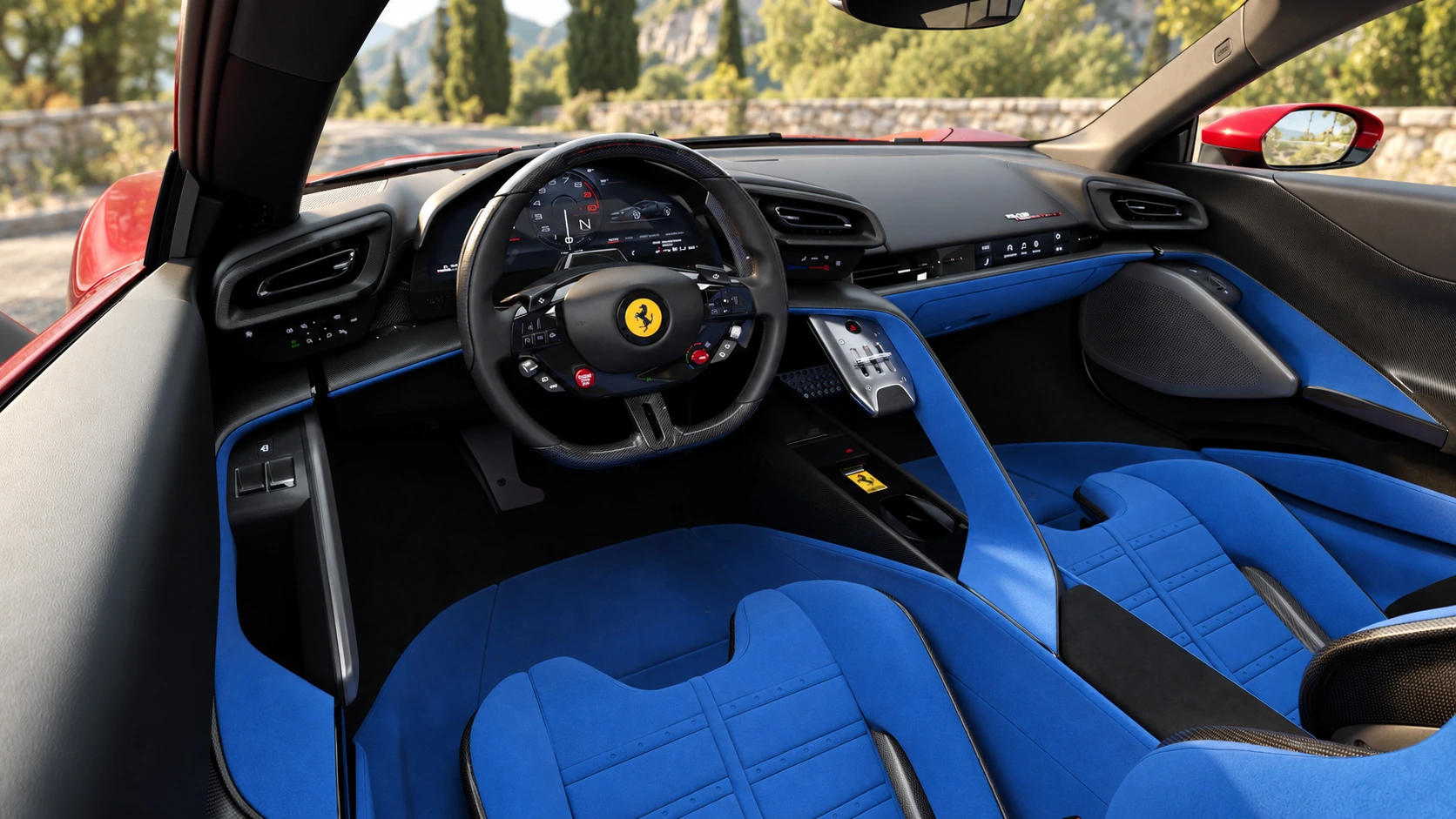
The design is easier to understand at eye level
In the product reference, the dark band across the nose, sharply defined surfaces and deep side opening give the car a graphic, almost architectural appearance. Inside, the driver’s instruments and the raised centre bridge create a much more enclosed-looking working space than the wide exterior view suggests.
These are observations about the design imagery. The next step would be to sit in the actual car. Check whether the view out suits your height, whether the steering position feels natural, and whether the controls you use frequently fall easily to hand.
Look at the cabin with your intended use in mind. A beautiful seat still needs to fit its occupant. A dramatic body shape still needs to negotiate the places where the car will be parked. That makes a seating and visibility check more useful than trying to judge everyday comfort from a photograph.
Read the symbols as carefully as the numbers
Ferrari’s acceleration claim uses “less than,” while its maximum-speed claim uses “more than.” Those qualifiers belong with the specifications. Turning either into an exact measured result would change what the manufacturer says.
Similarly, an acceleration result is a defined performance claim, not a description of every departure from rest. When comparing independent tests, read the test conditions, tyres, surface and measurement method. When comparing manufacturer figures, keep their qualifications attached.
The same care applies to power units. This article keeps Ferrari’s cv notation so the source remains clear. A comparison that switches between different horsepower conventions should identify the units and conversion rather than quietly treat every number as identical.
Questions worth asking before a demonstration
- Which specification is being shown? Confirm the options behind any performance claim and the equipment on the actual car.
- How will charging fit into ownership? Examine the connection, equipment and routine available at the intended parking location.
- Does the cabin fit? Try the seating, sight lines and controls at your own driving position.
- What is available locally? Ask for written details of the configuration, delivery timing, servicing and price in your market.
The 849 Testarossa’s appeal starts with an unusual combination of heritage and engineering. Understanding its specifications makes a more useful first step than treating the largest number as the complete story.
For a different approach to hybrid performance, read our Porsche 911 Turbo S T-Hybrid guide. Explore the Cars collection for more design and technology coverage.
Sources and method
- Ferrari — 849 Testarossa launch release and technical sheet, 9 September 2025
- Ferrari Beverly Hills — vehicle information and product design references
Manufacturer claims are identified above. Design observations and demonstration questions are ElitoLux editorial interpretation. We have not driven or independently measured this car. Read our research and corrections policy.