
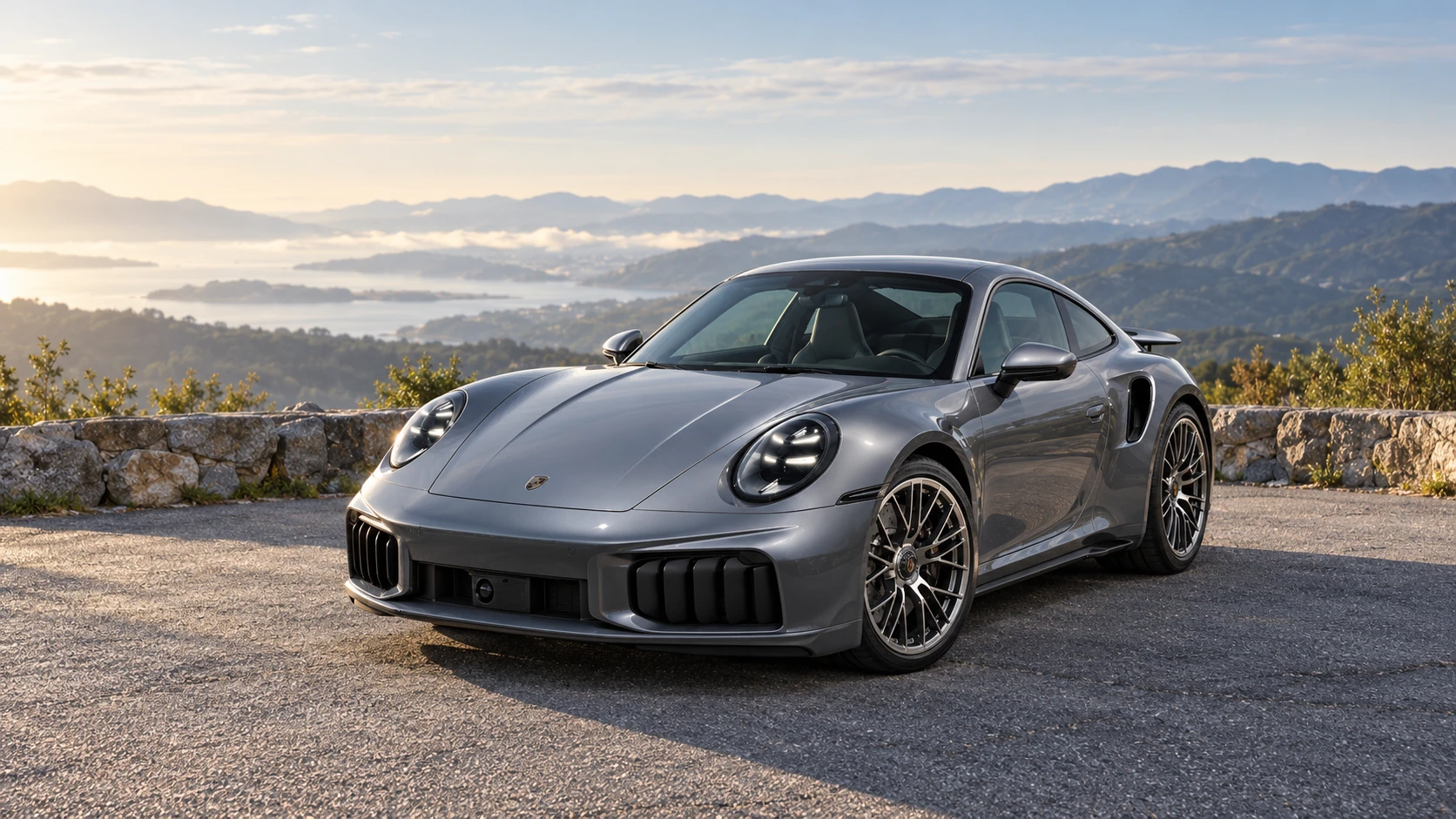
The 2026 Porsche 911 Turbo S puts electric motors inside its turbochargers and its gearbox. That is the engineering story behind the headline figure of 701 horsepower. Porsche has used electrification to change how its flagship 911 builds and delivers power, while keeping a rear-mounted flat-six at the centre of the car.
Introduced in September 2025 for the 2026 model year, this Turbo S brings the T-Hybrid approach already seen in the Carrera GTS to a more powerful, twin-turbo application. Here is what the published specifications tell us, and where they leave questions that require time behind the wheel. This is a technical analysis of Porsche's information, rather than a road test.
Checked 21 October 2026. Figures below refer to the Coupé unless stated otherwise. Images are AI-generated editorial illustrations based on Porsche reference images; they are not manufacturer photographs or evidence of a test drive.
The key numbers, with their units intact
| Specification | Published figure |
|---|---|
| Engine | 3.6-litre twin-turbo six-cylinder boxer |
| Combined system output | 523 kW / 711 PS / 701 hp |
| Maximum system torque | 800 Nm |
| Transmission and drive | Eight-speed PDK; all-wheel drive |
| High-voltage battery | 1.9 kWh gross; 400-volt system |
| 0–100 km/h | 2.5 seconds |
| 0–60 mph, US specification | 2.4 seconds with Launch Control |
| Top speed | 322 km/h |
The power figures describe the same rated system output using different units. The acceleration figures describe different target speeds. Treating 711 PS as 711 mechanical horsepower, or swapping a 0–60 mph time into a 0–100 km/h comparison, makes the car's performance harder to understand.
Sources: Porsche's US introduction, powertrain details and equipment specification.
What the T-Hybrid system actually does
Each of the two turbochargers has an electric motor between its turbine and compressor. Electrical assistance can spin the turbo shaft without waiting for exhaust flow to do all the work. That gives the engineers another way to control boost response.
The same machines can also recover energy from the turbo shafts. That electricity can feed the battery or the separate motor built into the PDK transmission. The gearbox motor contributes torque to the drivetrain; it has a different job from the motors that spin the turbos.
A compact, liquid-cooled battery at the front of the car supports this exchange of energy. Its 1.9 kWh gross capacity makes sense in the context of repeated power delivery. The useful question is how consistently the whole system responds as conditions change, rather than how impressive the battery capacity looks in isolation.
Source: Porsche: the T-Hybrid powertrain.
The chassis has to earn the extra power
Electrification adds hardware, and Porsche puts the overall increase in weight at 85 kg against the predecessor. That includes changes beyond the hybrid system. The trade-off deserves attention: extra performance and extra mass arrive together.
Standard electrohydraulic roll control, revised adaptive damping and a developed ceramic-brake package form part of Porsche's response. The front discs measure 420 mm; the rears measure 410 mm. Those details matter because accelerating, controlling body movement and slowing the car repeatedly are connected problems.
Porsche reports a 7:03.92 lap of the Nürburgring Nordschleife, approximately 14 seconds faster than the previous Turbo S. It is a manufacturer-reported result under its test conditions. It supports a claim about the complete package, but it cannot tell us how the steering feels on a broken road or how comfortable a long journey will be.
Source: Porsche: suspension and performance.
Familiar shape, more work happening in the airflow
The oval lamps, rounded roofline and broad rear body keep the Turbo S recognisable. Look closer at the nose, however, and the vertical cooling flaps reveal a more active relationship between cooling demand and airflow.
The new front diffusers work with those flaps. The front spoiler and adjustable rear wing also change their positions according to the situation. Opening an air path helps cooling, but it can alter the aerodynamic balance; the other surfaces have to account for that change.
Porsche's claim of up to 10 per cent lower drag coefficient applies when the aerodynamic elements occupy their most efficient positions. It should not be read as a universal reduction in fuel consumption. The dark Turbonite details give the flagship its own visual identity without requiring a dramatically different silhouette.
Source: Porsche: body, aerodynamics and design.
The cabin still has an everyday job to do
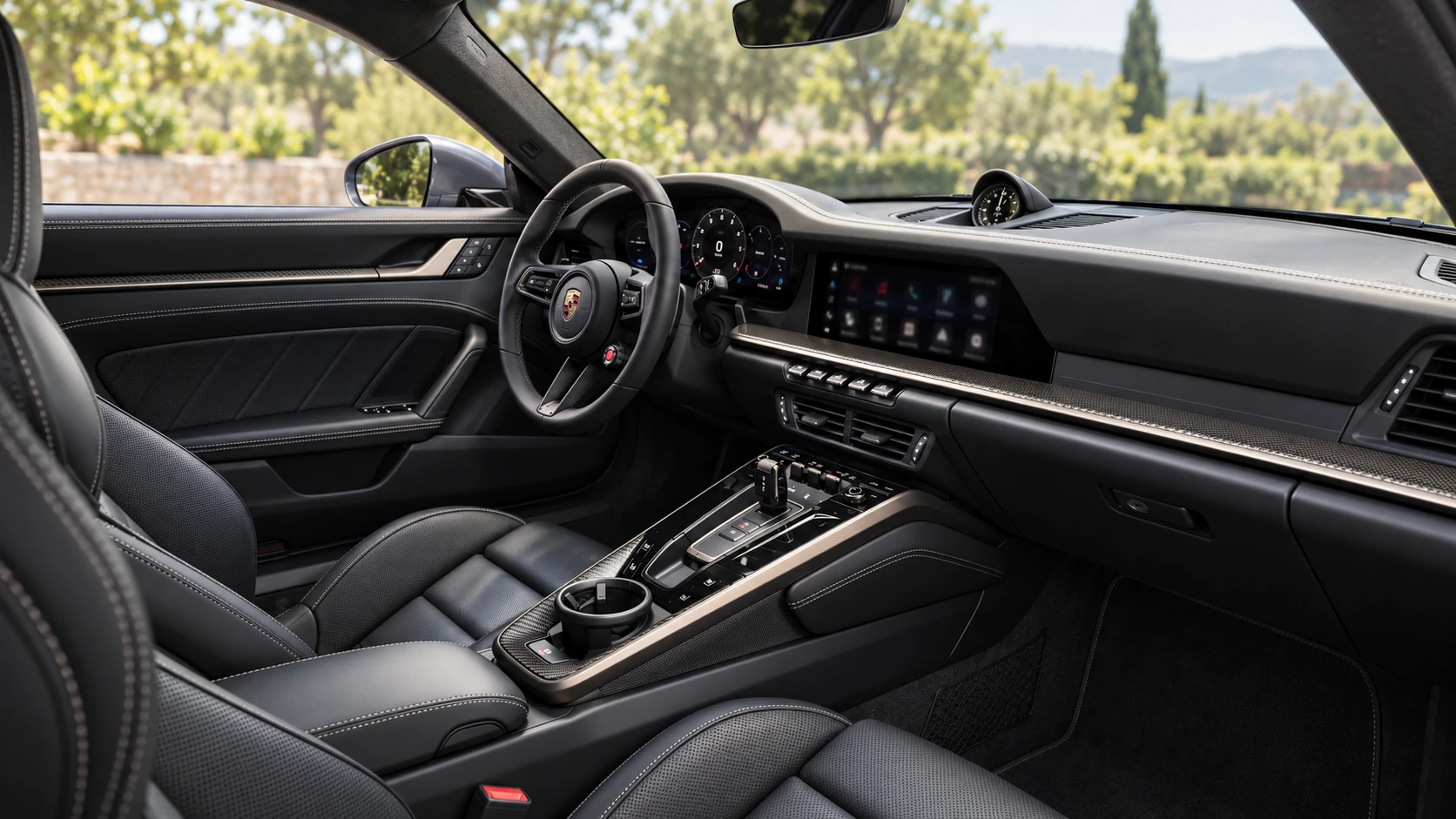
Black leather, anthracite accents and detailed stitching give the standard cabin a quieter character than the performance numbers might suggest. Porsche specifies heated GT Sports steering-wheel trim and 18-way adjustable Sports Seats with a memory function.
There is also a small configuration detail worth checking before comparing cars: the Coupé is specified as a two-seater, with the rear seating system available at no extra charge. The Cabriolet has four seats. A listing's photographs and option sheet therefore matter more than the assumption that every 911 has the same seating arrangement.
For an owner using the car regularly, seat fit, entry and exit, visibility and the usability of the controls will be part of the experience on every trip. Those are sensible priorities for a physical inspection. An image, including the illustration here, cannot establish them.
Source: Porsche: interior and interior packages.
Read the equipment list before adding options
Porsche's press specification includes rear-axle steering, Sport Chrono, centre-lock wheels, all-wheel drive and ceramic brakes as standard. A lower Sport suspension and a front-axle lift system are among the available options. Market-specific specifications should always be checked locally.
That distinction can change a comparison considerably. A more aggressive suspension setting may suit one use case; clearance on a steep driveway may matter more to another. Choosing equipment around the roads and journeys the car will actually encounter is more useful than treating every optional item as an automatic upgrade.
Source: Porsche: standard and optional equipment.
The question left for a proper drive
The T-Hybrid Turbo S is interesting because it brings several control systems together: electrical assistance, exhaust-energy recovery, active aerodynamics and chassis management. Published figures explain the design's intent. A careful road test would have to examine how naturally those systems work together, including in ordinary traffic.
For now, the strongest reason to pay attention is the engineering itself. There is much more to this generation than the badge or its peak output. If you enjoy examining different approaches to performance, explore our Cars collection and our separate look at the Tesla Roadster's published performance claims. Each story needs to be judged against its own evidence and development status.
Sources and editorial notes
This article uses Porsche's 2026-model introduction and its linked technical press-kit chapters. Manufacturer performance claims are attributed throughout. ElitoLux has not independently measured acceleration, lap time, efficiency or ride quality. No pricing, delivery-date or ownership-cost estimates are assumed. Specifications and availability can differ by market.
Both visuals were generated for this article using manufacturer reference images. They illustrate the subject and should not be used to confirm an exact vehicle specification. Browse all ElitoLux stories for more reporting on cars, private aviation, yachts and technology.